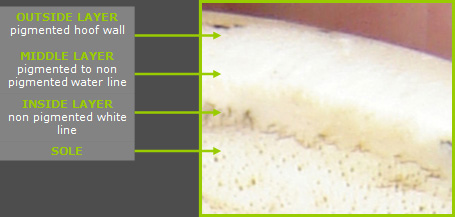
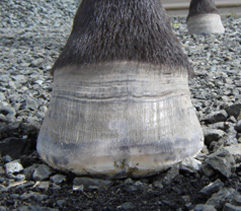
WHITE LINE DISEASE...White line disease [also called seedy toe, stall rot, hollow foot, candida, yeast or thrush infection or incorrectly onychomycosis] are commonly used terms for a condition which is not a disease, but simply the presence of bacteria and|or other micro organisms which have entered a tissue space within the hoof because it has been compromised in some way. Pathogens inhabit the tissue space and under favourable conditions, multiply and destroy healthy tissue. This can result in varying degrees of infection and in extreme cases, loss of the connection which exists between the inside layer of the hoof wall and the coffin bone. The hoof wall is made up of three distinct layers :
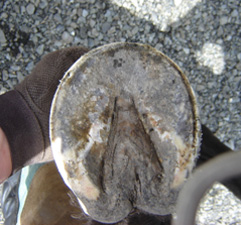
White line disease originates at the solar surface of the hoof at the junction where the middle layer bonds with the inside layer and is apparent as a separated or striated area which is greyish or black in colour, and has a softer than normal or gooey texture. The area may be extremely small or large or located in one or several places on the same hoof and may manifest on one or more hooves. The appearance of white line disease on the solar surface often disguises a larger area of tissue which has been destroyed within the hoof wall. The infection usually travels upwards towards the coronary band and upon investigation by a skilled and experienced hoof care professional, will usually reveal a limited area of infection which once excavated or opened up to light and air is of little consequence for the horse. On other occasions more aggressive combinations of organisms cause extensive damage which upon investigation is represented by a cavernous space within the hoof. This area may be localised, or may involve a larger area which has greatly compromised the connection between the inside layer of the hoof wall and the coffin bone. It is therefore important to attend to treatment to both aid healing and prevent the spread of further infection. What causes white line diseaseWhite line disease is usually caused by bacteria or other micro organisms entering a tissue space within the hoof from the following :
Methods to resolve white line diseaseWhen the area of infection is small and limited, white line disease usually resolves itself over time, as long as correctly applied barefoot trimming techniques are maintained at intervals recommended by a skilled and experienced barefoot hoof professional.When extensive damage has occurred, it is important that the infected area is excavated by a skilled and experienced barefoot hoof professional or veterinarian who will ensure the area is opened up to the light and air without compromising the structure of the hoof. It is helpful if the tissue space can be cleaned out carefully on a daily basis and sprayed with long acting anti-bacterial and anti-fungal preparations, with organic unpasteurised apple cider vinegar or with homeopathic hypericum|calendula ('hypercal') lotion. It is helpful if the horse is able to have as much free exercise as possible in a dry area [as wet living conditions soften the hoof a little, which allows easier entry of debris, bacteria etc] to encourage circulation and to support the healing process. By creating a stress free and as natural as possible lifestyle ensures that the horse has a strong and active immune system which is more able to adequately defend itself when necessary. Aggressive treatment usually by way of resecting a large area of the hoof, or acrylic repair to extensively damaged areas are not recommended as they inhibit natural healing, weaken the structure of the hoof wall, prevent daily cleaning and may harbour further infection. Most importantly however, it is crucial that the cause of white line disease is removed, which is attained by ensuring the horse is trimmed at intervals recommended by a skilled, experienced and knowledgeable barefoot hoof professional who applies a correct barefoot trim. This is essential for maintaining hooves which must have a strong and tight bond between the inside hoof structures and the coffin bone, thus preventing the occurrence of white line disease. Also important is that the white line is picked out efficiently and frequently and that any injury or wound sustained receives adequate attention to prevent the invasion of opportunistic pathogens.
The left top and bottom photos show the hoof of a horse prior to it's first corrective barefoot trim. The horse suffered continually with white line disease and abscesses which were more common during the winter months. Despite veterinary intervention - shown by excavation at the toe, both conditions did not resolve themselves which was costly and frustrating for the owner, and very painful for the horse. The right top and bottom photos show the hoof after six months of corrective trimming applied at four weekly intervals. The hooves whilst not in a correct or functional shape at that time, were well on their way to becoming tough and healthy. The white line disease was completely resolved and there has been no further occurrence of abscesses since the first corrective trim was applied. Prior treatment by a veterinarian who had excavated three of the four hooves in the toe region, as well as administering antibiotics had failed to resolve the situation and the horse continued to be in distress and pain. What was most frustrating and is a situation which occurs almost every time, is that the cause of the white line disease and frequent abscessing was not addressed by the veterinarian, which was simply too infrequent trimming and also incorrect trimming of the hooves. No recommendations to obtain a correct barefoot trim was given to the owner. The ability to look at each case holistically is also extremely important and it was noteworthy in this case, that the horse was very old, was grazed in small paddocks with only one other horse, and did not have any exercise. Since the first corrective barefoot trim, and after consistent four weekly trims over six months, the hooves have been white line disease and abscess free, as at the date of publishing this case study. There is no doubt that the hooves will remain this way as long as this schedule is continued. Further information about homeopathy, contacting a homeopath, bitless training or barefoot trimming may be viewed on the 'profile', 'photos', 'info' or 'testimonial' sections of the website or by contacting Horse & Human by email, phone or text. |
||||||||||||||