BITLESS BRIDLES - THE THREE TYPES + REVEALING THE DISCOVERY OF THEIR SUCCESS...Life isn't always easy and insightful revelation is often the result of living through and learning from challenging situations. This occurred when I bought my first horse, Tye. After experiencing many emotionally frustrating and physically painful situations with him, I discovered very simple and easy solutions by changing the way I interacted with him, which he understood and responded to effortlessly. I found that numerous other horses also respond similarly to this approach, though these methods completely oppose traditional teaching on handling horses and riding them. By understanding how horses communicate naturally, I was able to gain an insight into why bitless bridles are so effective, and why bitted bridles [apart from the terrible pain, dysfunction and psychological torment] cause so much confusion for the horse. This article looks at the three different types of bitless bridles available and also reveals the small but absolutely vital difference in communication that exists between a non bitted bridle and one that is bitted. As horses are necessarily almost silent creatures, they rely on a non verbal way of communicating with one another which reinforces this order. The way they do this is by a more dominant horse creating a situation of pressure which is directed at a less dominant horse. The more dominant horse initiates a physical movement along with an 'energy' of purposeful intent which can be as small as a flip of the nose or a glare, or more aggressive depending on the situation. The less dominant horse obeys instantly and without question by moving away from the source of the pressure or discomfort. By moving away from the situation of pressure, the less dominant horse gains a release. If it does not move quickly enough, more violent reinforcement soon follows. I have named this specific form of horse communication MOVING AWAY FROM PRESSURE (MAP). 
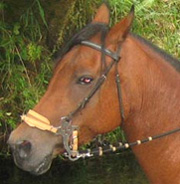
Example : the above photo shows the dominant herd leader - a bay mare moving purposefully with her ears pinned back towards the less dominant covered appaloosa. It's obvious she is showing a high intent or energy which correlates with her body movement. The less dominant horse understands this language very clearly, quickly moves away from the cause of pressure - the mare, and by so doing gains a release from the pressure or discomfort. In fact this natural cause and effect is common - as humans we also move away from pressure or discomfort emotionally or physically, although we possess verbal skills to communicate as well. As an example, if a person pricks you with a pin, one would naturally move away from the discomfort. If a person invades your personal space, again one naturally feels inclined to move away. Horses rely on this single non verbal way of communicating in every interaction they have with one another, every day of their lives, and it is never forgotten or ignored. In the photo below the horse wears a rope halter with a lead rope attached by a knot and made into reins. The point of pressure on the right side of it's face is clearly seen, as the left rein is pulled or opened. Whether the head piece is a side pull bitless bridle, a crossover bitless bridle or simply a rope halter or head stall with reins attached, the horse always feels pressure on the opposite side of it's face to the rein that is being pulled or opened. When a left rein is used, one is asking the horse to move to the left. As the horse feels pressure on the right side of it's face, it quickly MOVES AWAY FROM PRESSURE to gain a release, just as it would when interacting with members of it's herd. 
A bitted bridle does not use the same kind of natural language. Instead it relies on a principle of asking the horse to move INTO pressure - and it is this flawed methodology which contributes to an enormous amount of confusion for the horse. In the photo below the horse wears a normal bitted bridle. Along with various other painful assaults on the sensitive mouth area, the bit squeezes down and rubs continually on the bars in the mouth - the gap of cushioned bone which lies between the front and back sets of teeth, and where the bit lies. The main point of pressure is clearly seen on the left bar as the left rein is pulled or opened. Whilst the horse may feel a very slight amount of pressure on the right side of it's face from the ring or shank butting up to the corner of it's mouth as the bit slides through, the pressure is felt significantly more on the left bar. When wearing a bitted bridle, the horse always feels pressure on the same side of it's mouth to the rein that is being pulled or opened. It is then required to move INTO that pressure to gain a release. 
Creating pressure on the bar of the mouth, and then requiring a horse to move INTO that pressure is like speaking a foreign language to them, and is absolutely opposite to what they do naturally. This miscommunication creates confusion and along with the pain and interference of physiological functions caused by the bit, escalates anxiety to levels that are often dangerous. Some of the most fundamental and basic skills taught to an inexperienced rider is how to ask a horse to move, turn, slow down and stop. In fact it is these few seemingly simple requests which often cause the most amount of frustration, fear and danger to even experienced riders, with horses who stubbornly resist or react frighteningly to all efforts. With riders the world over experiencing such common problems, one must therefore speculate, and it is also my experience, that the means by which we ask a horse to do these things is inhumane, ineffective and dangerous. As an example, if one was racing a car, it would be ridiculous to press the horn to make it stop. Unfortunately a bitted bridle communicates requests equally as ineffectively to the horse as a horn would in stopping a car. A bitted bridle is a completely ineffective tool of communication, and simply does not work in a way that the horse understands. There are just a few varieties of bitless bridles – all with slightly different actions and looks, but most importantly all use the correct principle of creating pressure on the opposite side of the horse's face to the rein that is being pulled or opened, and then asking the horse to MOVE AWAY FROM PRESSURE [except for mechanical hackamores]. As well, they have the added benefit of not using pain as a way of controlling the horse, nor do they interfere with vital bodily functions as a bitted bridle does. Communication with the horse becomes simple and clear, and it responds willingly and peacefully. THE KNOTTED ROPE HALTER - SIMPLE : QUICK : VERSATILE : DURABLE : EFFECTIVE Other : Rope halters are machine washable, durable, strong and don't usually require any particular maintenance. They are available in a variety of colours and one halter usually fits a variety of similar sized horses, although there are definite differences between mini, pony, cob and horse sizes. The Nungar Knots brand manufactured in Australia from www.nungarknots.com.au is highly recommended. These halters are very soft and supple, but strong and hardwearing unlike cheaper versions. Also recommend is a Nungar Knots 3.6 metre 'suityaself' lead rope which has a detachable metal clip. By detaching the clip, it is easy to loop the spliced end through the halter chin loop, which then becomes a gentle lead rope training tool, and also easy to make into a bitless bridle. As Nungar Knots is a wholesale company, a distributor can be easily sourced by viewing their website, and arranging purchase and postage to NZ. More information about how to attach a lead rope to a halter or how to make reins from a lead rope may be found in the 'articles' section of the website. 
Other : Crossover bitless bridles are available in synthetic or leather and come in a variety of colours and brands. Depending on the material used, they may or may not require particular maintenance or cleaning, however do require more fitting than a rope halter. 

Hackamore (German, English, Mechanical etc) bitless bridles are not recommended, for even though they are bitless, they use leverage, discomfort and pain to control the horse, as well as the incorrect principle of requesting a horse to move INTO pressure. Two metal shanks run from the nose band downwards, where the reins attach at the bottom. When one or both the reins are used, tension is created on the side pieces, which creates pressure on the poll [top of the head]. This pressure rotates the metal shanks which then poke into the soft, sensitive mouth and cheek area. When this force is applied it also causes the nose piece, which is often made from materials such as hard leather or metal, to rotate and press onto the sensitive and nerve rich bridge of the nose. Some hackamores use serrated metal nose pieces which magnify the agonising pain and cause extremely painful bruising and lacerations. The horse is required to move into this pain, to gain a release from it which is un natural to the horse and very confusing for it. Depending on how much pressure is applied, the horse tries to avoid the pain by over flexion or over extension of the neck and poll, which creates obstruction of breathing with resultant lung impairment, as well as overly contracted and stretched muscles, ligaments and tendons in the head, neck and back area. Further information about bitless training or barefoot trimming may be viewed on the 'profile', 'photos', 'info' or 'testimonial' sections of the website or by contacting Horse & Human by email, phone or text. |