CREATION OF PRESSURE : MOVING AWAY : RELEASE [what : when : how : why]...
Horses are naturally very obliging and peaceful creatures. They are in complete harmony with their environment and possess highly refined senses and reflexes to enable their survival. One vital aspect of herd life is hierarchical structure. The herd has the most dominant of all the horses as it's leader, with progressively less dominant horses following in sequence below one another. This structure ensures orderliness and exists so that minimum energy is expended in completing every day activities, as each horse knows it's exact position within the herd.
Establishing dominance and clear communication
As horses are necessarily almost silent creatures, they rely on a non verbal way of communicating with one another which reinforces this order. The way they do this is by a more dominant horse creating a situation of pressure which is directed at a less dominant horse. The more dominant horse initiates a physical movement along with an 'energy' of purposeful intent. This can be as small as a flip of the nose or a glare, or more aggressive depending on the situation. The less dominant horse obeys instantly and without question by moving away from the source of the pressure or discomfort. By moving away from the situation of pressure, the less dominant horse gains a release and the more dominant horse reinforces it's dominance. If the less dominant horse does not move quickly enough, more violent reinforcement soon follows. I have named this specific form of horse communication MOVING AWAY FROM PRESSURE [MAP]. Horses rely on this non verbal communication in every interaction they have with one another, every day of their lives, and it is never forgotten or ignored. By utilising this same principle in every single interaction one has with a horse, dominance is established [absolutely without any use of control, pain or abuse], which in turn creates respect and builds very clear channels of communication.
Consistent kindness
From past experiences, the majority of horses have learned that humans are to be feared, so whilst they don't often show acts of kindness to each other, in a horse-human relationship it is extremely important to also treat the horse with consistent kindness. Kindness doesn't mean the best saddle or prettiest cover however. It means making allowances and tolerating individual personalities and sensitivities, perhaps from negative past experiences. It means understanding the horse is a prey creature and has inbuilt prey reactions which cannot be suppressed. Not expecting the horse to act like a machine - that it has it's own levels of ability to withstand various challenges, and that it is never pushed into a stressful situation or beyond it's limits. It is understanding that the horse may have experienced all kinds of upsets - perhaps a fright, injury, reshuffling herd hierarchy from the addition of a new member, violent weather conditions, strange noises or sights, or various other things which may happen and are unknown to the handler. And it also means spending quiet time with them, learning what they like and respond to best - perhaps it may be gently scratching their ears or giving them some apple, or simply standing quietly together. By showing consistent kindness, a bond of deep trust is formed between horse and handler.
What is pressure + release
Pressure means various things. Horses are designed to detect the threat of pressure in their environment by possessing superior senses, and reacting in split seconds. If a horse sees something which it detects as a threat it responds by fleeing. Horses also use the threat of pressure with one another to reinforce hierarchical structure. A more dominant horse will use a glare, pinning ears back, a flip of the nose, walking into another horse's space or actual pressure such as a nip or a kick whenever they interact with a less dominant horse. When a human interacts with a horse, natural horse behaviour should be duplicated as closely as possible. For instance a threat of pressure may be duplicated in human terms as the end of a lead rope swinging but not touching a horse's rump instead of in horse language - pinned back ears. And actual pressure may be duplicated in human terms as the end of a lead rope contacting the horse's rump instead of in horse language - a kick.
Whether a threat of pressure or actual pressure, all non verbal communication contains an 'energy' of purposeful intent which ranges from very gentle to very aggressive. And no matter what it is, all request a horse to do one thing - to take action by MOVING AWAY FROM PRESSURE.
Conversely, release from pressure means no threat and very little or no action, combined with an 'energy' of calmness, peacefulness, gentleness, relaxation or comfort. For instance a horse experiences a release by running out of the way of potential danger, or moving out of the way of a more dominant horse and then being able to stand relaxed, grazing, napping etc. When a human interacts with a horse, the human has control of when the release from pressure is given and by ensuring it is given quickly with a calm 'energy' of intent, and for extended periods of time, this creates a very positive learning environment.
When is a release given
A release is given as soon as the horse moves in a way that has been requested - even one step or the slightest small bend of the head. Whatever it is, and no matter how small - this is extremely important. Traditional training sessions commonly become an endless task, or a battle of wills between horse and handler. There is no release, and therefore no communication to let the horse know that what they are doing is what the handler wanted. This causes the horse to become numb, stop listening, lose interest, become frustrated or increasingly agitated. Often this type of training has a reverse effect, as the horse doesn't understand what is required of them, and also whether what they did was right. Initially training or riding sessions should be very short - just a few minutes usually with periods increasing as the horse is able to adjust and cope with them, and dependent on their individual personality, past experiences, abilities and sensitivities on the particular day.
How is a release given
The release is given by instantly relinquishing pressure on the lead rope, rein or any particular thing that is causing pressure, by immediately ceasing to ask for anything, and by lowering the 'energy' of purposeful intent and allowing the horse to relax. By releasing pressure quickly and engaging in little or no movement or by quietly standing together, or gently rubbing, scratching or stroking a particular spot that the horse enjoys - for an extended period of time, is when deep learning is able to take place.
Often handlers will praise their horse in a human way which actually causes confusion or fear, and undoes the excellent training which has previously been implemented. When humans do something that excites them or win the praise of their peers, there is lots of high energy, wide facial expressions, loud vocalisation and quick body movements. For instance, if someone has performed well in an exam, ones friends would smile and laugh with wide eyes, shout 'well done', slap the person on the back or shake hands vigorously, or even jump around and whoop it up! For a horse, this kind of high energy and action is actually quite frightening. So after the horse has done something well - before one slaps the horse a few times hard and fast on the neck with a loud 'well done Trigger, WELL DONE!!' one must remember that this is human language not horse language. A reward to a horse simply means a release from the threat of pressure or a release from actual pressure, and instead - calm quietness, gentle rubbing, or simply doing nothing.
Also often handlers will give food treats or some signal of reward, such as a clicker. This is very confusing for the horse, as it develops respect for the food, rather than the handler. Food reward training can result in crowd pleasing tricks being taught through repetition, however trust, respect, clear communication and comprehension can only be accomplished by using the horse's own language - which is the creation of pressure and subsequent release by moving away. Using food as a reward has an added problem of individual horses not being particularly interested in food rewards or those that become pushy, nippy and demanding. Often they will lose interest in the training and become impatient if the reward is not forthcoming quickly, or when they want it. There is nothing wrong however with gentle activities, calm quietness and a feed at the end of any interaction, but food used as a learning tool is inappropriate and is more in tune with predator type training, rather than horse training.
Why is a release given
Utilising pressure and quick release with extended time relaxing when interacting with a horse is extremely important. It is the way in which horses non verbally communicate with one another and by using this and duplicating it the best way possible in human terms, in every interaction one has with a horse - one simply talks their language. For the horse, who is naturally obliging and peaceful - requests are comprehended clearly and compliance is respectful and effortless.
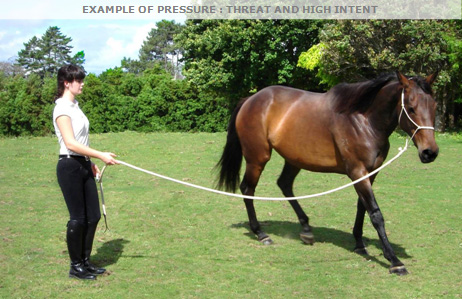
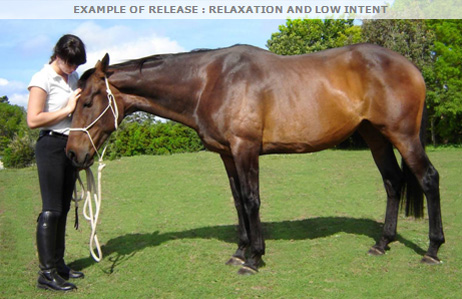
Example : the photos above show Misty trotting around me on a circle. I am non verbally communicating with her in her own horse language which she comprehends effortlessly, and then obliges calmly and willingly. The threat of pressure at her rear comes from the end of the lead rope and there also is actual pressure, albeit very slightly behind her ears on the halter from opening the lead rope and holding it in direction I require. Misty perceives the threat of pressure from the end of the lead rope and moves away from it. She also feels a slight pressure on her head from the halter and moves away from it - resulting in easy lunging. Comparing the two photos it is clear to observe that in the top photo I have an 'energy' of purposeful intent when asking her to move and in the lower photo a more relaxed body language and energy at the release. Once she does as I've asked, even a step sometimes, I invite her in to the centre, where she receives a release. This means no movement, quiet energy, scratches and rubbing that she enjoys - for an extended period of time.
By acting in a consistently kind way, establishing dominance and building clear communication by using the horses natural way of interacting with each other cements a strong and enduring relationship. The horse is trusting, calm, peaceful and safe. It is respectful, responsive and willing. It understands what is expected of it quickly and effortlessly and begins to comprehend that training and riding sessions [pressure] are not terrifying or lengthy experiences to be endured, but that they are actually no bother, because of the frequent and extended periods of release throughout every interaction.
Further information about bitless training or barefoot trimming may be viewed on the 'profile', 'photos', 'info' or 'testimonial' sections of the website or by contacting Horse & Human by email, phone or text.