HOOF ABSCESSES...At one time or another you may have visited your horse and found them unwilling or unable to walk - instead hopping or hobbling along, looking extremely pitiful as if they've broken a leg. Apart from the obvious guess of soft tissue injury or indeed perhaps a wound or fracture - there maybe something else to consider - that a hoof abscess is developing. Frustratingly, often there are no other signs of an abscess apart from a loss of function - a reluctance to place weight on the hoof, which can range from slight to extreme, depending on the stage at which the abscess has been discovered. In the first stages as well as pain, there will also most probably be redness, swelling or heat in the general area, which are the classic signs of inflammation. Sometimes these are visible or able to be felt, but more commonly the abscess is located too deeply and therefore it is impossible to see or feel these symptoms. There may be a strong or bounding pulse in the lower leg [called the digital pulse] which is stronger or quicker from the pulse in the other legs. The digital pulse is located by feeling gently around the inside area of the limb when it is weighted, around where the long pastern bone is located. Finding the digital pulse is usually quite difficult, so if it's found very easily, that may in itself be an indication that the pulse is stronger than normal. It's a good idea to find the digital pulse and rate of beats per minute when the horse is well, so you can quickly ascertain when they are ill. Other signs can sometimes be a lack of interest in food, general lethargy or look of being unwell, or excessive thirst.
An abscess is simply an area of infection in an enclosed tissue space which the immune system encapsulates so as to limit damaging a more widespread area. The area is filled with pus comprised of dead immune defender cells, cell debris, serum, living and dead microbes etc and causes a great deal of pain for the horse, especially in the first stages. The responses triggered by the immune system isolate, inactivate and remove the causative agent and damaged tissue by digesting and disposing of abscess contents, as well as being removed via the lymphatic system. Superficial abscesses tend to rupture through an area of least resistance such as the coronary band or white line, discharging the characteristic yellow/green coloured sticky fluid which has an offensive odour. Once the abscess has burst and is draining freely or the body has been able to resolve the inflammation, the pressure within the hoof capsule is relieved almost instantly.
What causes a hoof abscess
Orthodox methods to alleviate an abscess
If an abscess is superficial enough for intervention to be considered by a veterinarian, then it will usually resolve itself without it, or at the most - with a very small amount of excavation to relieve the pressure and allow drainage. If the abscess is deep and cannot be located, then such invasive procedures should not be considered at all. However with a horse in tremendous pain, supporting the natural process of inflammation and assisting the abscess to break out and drain thus alleviating the pain quickly is extremely important. In this regard natural medicine can be of enormous benefit and support.
Natural methods to support the healing process Homeopathic remedies are also very helpful in resolving acute situations as well as chronic tendency to abscess. Remedies commonly used for inflammation and pain, assisting the abscess to break and drain, as well as ensuring deeper infection is avoided are very successful. Assistance should be always be obtained by a qualified and experienced homeopath however, who will prescribe the most appropriate remedies for the individual situation. More information about homeopathy and to contact a Homeopath may be located in the articles + movies section of the website. Soaking the hoof in hot water, or applying hot compresses with either epsom salts, organic and unpasteurised apple cider vinegar or 'hypercal' lotion ['hypercal' is a combination of pain relieving hypericum and healing calendula obtainable at usually any pharmacy] may assist in breaking and healing the abscess.
An increase in circulation from increased movement is extremely beneficial in assisting the abscess to break and drain quickly and efficiently, although most probably it will be a rather impossible task with a most reluctant horse. It is therefore best to keep a horse in a herd situation, where they will be required to move naturally, rather than to isolate or stable them, where movement becomes inhibited, and thus healing delayed. Because circulation should be increased or at least maximised, restrictive bandaging is also not recommended.
How to avoid abscesses occurring
Very deep abscesses, chronic susceptibility to abscess frequently or unresolved abscesses are an indication that the health of the horse is being compromised in some way. Therefore trimming techniques along with living conditions, riding surfaces, situations the horse finds stressful and orthodox methods of treatment should be investigated thoroughly. By creating a stress free and as natural as possible lifestyle ensures that the horse has a strong and active immune system which is more able to adequately defend itself when necessary. But most importantly, and this is crucial - it is the application of a correct barefoot trim at intervals recommended by an experienced and knowledgeable barefoot hoof professional which is essential for healthy hooves.
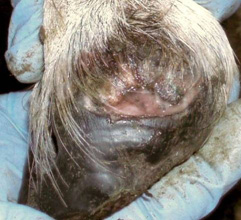
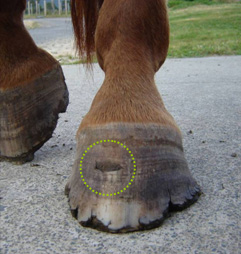
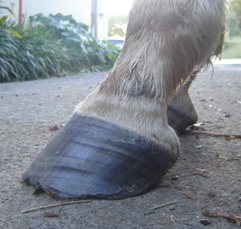
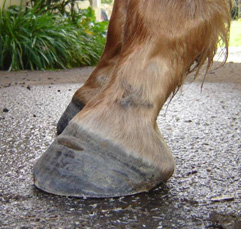
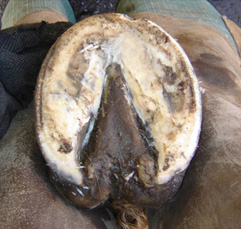
The left top and bottom photos show the hoof of a horse prior to it's first corrective barefoot trim . There are no obvious signs of an abscess, although the horse was extremely lame and refusing to place weight on the left front. The right top and bottom photos show the hoof with the abscess growing out, after four corrective barefoot trims applied at four weekly intervals . The hoof has not abscessed since the corrective trims have been applied. Prior treatment by a veterinarian who had excavated several areas in the toe region as well as administering antibiotics had failed to locate the abscess or assist the abscess in bursting|draining and the horse continued to be in distress and pain. What was most frustrating and is a situation which occurs almost every time, is that the cause of the abscess was not addressed by the veterinarian, which was simply too infrequent trimming and also incorrect trimming of the hooves. No recommendations to obtain a correct barefoot trim or other advice - for example to increase movement were given to the owner. The ability to look at each case holistically is also extremely important and it was noteworthy in this case, that the horse was fairly old, was grazed in small paddocks on it's own and did not have any exercise from a human.
On observation prior to the first corrective barefoot trim, the heels were excessively high which incorrectly distributed weight onto the front area of the hoof - an area not designed to incur such extreme force, and which most probably contributed to compression of tissue. The toes were too long which had resulted in flares, and there were numerous and deep splits and cracks which contributed to the invasion of opportunistic bacteria. As well, the long toe had stretched and weakened the laminar connection and contributed to excessive leverage force on break over. Further information about homeopathy, contacting a homeopath, bitless training or barefoot trimming may be viewed on the 'profile', 'photos', 'info' or 'testimonial' sections of the website or by contacting Horse & Human by email, phone or text. |
||||||