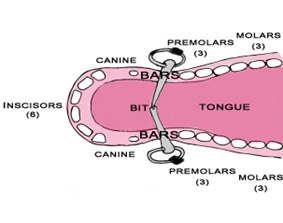
THE TRUTH ABOUT BITS - PART 2 : ABOUT THE BIT...The first known bits were made out of rope, bone, wood or horn. Bronze bits came into use around the 1300's and horses have been fitted with metal bits ever since. What was used first is unknown - a bitless bridle or one that was bitted, as the materials used in both bridles were unable to be preserved over the passage of time. A bit is described as a piece of metal [or tough material] that is placed over the tongue in the horse's mouth and which sits across the bars in the mouth [a space of gum covered bone which lies between the two sets of front and back teeth]. The bit is held firmly in the mouth by the bridle, which forms an inescapable circle around the horse's head and nose. Reins are attached to the ends of the bit, which the handler pulls either singly or in combination, either lightly or harshly to control or direct the horse. Reins [and therefore the bit] are often used by most riders to maintain balance or to regain and recover from over balancing.
Most equestrians are taught that a bit equals control. Therefore by this premise it is thought that no bit equals no control. This is a well known and widely accepted misconception, which is perpetuated by instructors in equitation who have little knowledge or comprehension of the anatomy, physiology or psychology of the horse. Contact or pressure on the reins [therefore the bit] is required at all times during almost all riding disciplines, which not only requires the horse to move INTO pressure, which is a completely un natural response for a horse - and also actually for a human, but just by the placement of the bit in the sensitive oral cavity creates enormous amounts of pressure on the horse's external and internal mouth. It also interferes with the structures and functioning of the airway as well as the joints and soft tissue of the head, neck and back. From the simple act of placing a piece of metal in a horse's mouth, a chain of negative events are set in motion, which often culminate in fatal injuries for both horse and|or handler. Horses are naturally very obliging and peaceful creatures. They are in complete harmony with their environment and possess highly refined and acute special senses and reflexes to enable their survival. One vital aspect of herd life is hierarchical structure. The herd has the most dominant of all the horses as it's leader, with progressively less dominant horses following in sequence below one another. This structure ensures orderliness and exists so that minimum energy is expended in completing every day activities, as each horse knows it's exact position within the herd. As horses are necessarily almost silent creatures, they rely on a non verbal way of communicating with one another which reinforces this order. The way they do this is by a more dominant horse creating a situation of pressure which is directed at a less dominant horse. The more dominant horse initiates a physical movement along with an 'energy' of purposeful intent. This movement can be as small as a flip of the nose or a glare, or more aggressive depending on the situation. The less dominant horse obeys instantly and without question by moving away from the source of the pressure or discomfort. By moving away from the situation of pressure, the less dominant horse gains a release. If it does not move quickly enough, more violent reinforcement soon follows. I have named this specific form of horse communication MOVING AWAY FROM PRESSURE (MAP). 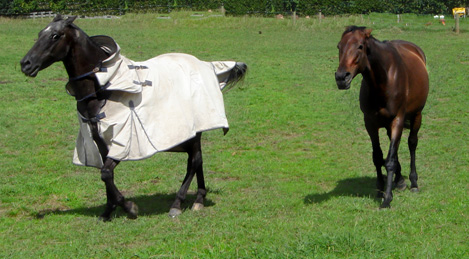
Example : the above photo shows the dominant herd leader - a bay mare moving purposefully with her ears pinned back towards the less dominant covered appaloosa. It's obvious she is showing a high intent or energy which correlates with her body movement. The less dominant horse understands this language very clearly, quickly moves away from the cause of pressure - the mare, and by so doing gains a release from the pressure or discomfort. In fact this natural cause and effect is common - as humans we also move away from pressure or discomfort emotionally or physically, although we possess verbal skills to communicate as well. As an example, if a person pricks you with a pin, one would naturally move away from the discomfort. If a person invades your personal space, again one naturally feels inclined to move away. Horses rely on this single non verbal way of communicating in every interaction they have with one another, every day of their lives, and it is never forgotten or ignored. It is upon this natural, simple, sound and effective principle of communication - of creation of pressure and MOVING AWAY FROM PRESSURE - that all bitless bridles, except a mechanical hackamore are based upon [albeit unknowingly by the manufacturer]. They all create a small amount of pressure on the side of the face which is opposite to the rein being pulled or opened. The horse naturally moves away from this pressure, thus creating a release from it. This is communication that is so natural to the horse, it understands it effortlessly and obliges willingly and peacefully. In the photo below the horse wears a rope halter with a lead rope attached by a knot and made into reins. The point of pressure on the right side of it's face is clearly seen [green arrow], as the left rein is pulled or opened. Whether the head piece is a side pull bitless bridle, a crossover bitless bridle or simply a rope halter or head stall with reins attached, the horse always feels pressure on the opposite side of it's face to the rein that is being pulled or opened. When a left rein is used, one is asking the horse to move to the left. As the horse feels pressure on the right side of it's face, it quickly MOVES AWAY FROM PRESSURE to gain a release, just as it would when interacting with members of it's herd. 
A bitted bridle does not use the same kind of natural language. Instead it relies on a principle of asking the horse to move INTO pressure - and it is this flawed methodology which contributes to an enormous amount of confusion for the horse. In the photo below the horse wears a normal bitted bridle. Along with various other painful assaults on the sensitive mouth area, the bit squeezes down and rubs continually on the bars in the mouth - the gap of cushioned bone which lies between the front and back sets of teeth, and where the bit lies. The main point of pressure is clearly seen on the left bar as the left rein is pulled or opened. Whilst the horse may feel a very slight amount of pressure on the right side of it's face from the ring or shank butting up to the corner of it's mouth as the bit slides through, the pressure is felt significantly more on the left bar. When wearing a bitted bridle, the horse always feels pressure on the same side of it's mouth to the rein that is being pulled or opened. It is then required to move INTO that pressure to gain a release. 
Creating pressure on the bar of the mouth, and then requiring a horse to move INTO that pressure is like speaking a foreign language to them, and is absolutely opposite to what they do naturally. This miscommunication creates confusion and along with the pain and interference of physiological functions caused by the bit, escalates anxiety to levels that are often dangerous. Some of the most fundamental and basic skills taught to an inexperienced rider is how to ask a horse to move, turn, slow down and stop. In fact it is these few seemingly simple requests which often cause the most amount of frustration, fear and danger to even experienced riders, with horses who stubbornly resist or react frighteningly to all efforts. With riders the world over experiencing such common problems, one must therefore speculate, and it is also my experience, that the traditional means by which we ask a horse to do these things is inhumane, ineffective and dangerous. When a rider is on a horse galloping at around 30 mph|50 kmph, one must be extremely confident on the means used to turn, slow or stop it. It is ridiculous to expect a horse who experiences an excruciating amount of pain, along with great fearfulness and physiological suffering to be able to calmly listen and respond the correct way to a rider. As well, when the method of communication is so ineffective and is actually the source of pain and suffering - it becomes downright foolish! As an example, if one was racing a car, it would be ridiculous to press the horn to make it stop. Unfortunately a bitted bridle communicates requests equally as ineffectively to the horse as a horn does in stopping a car. A bitted bridle is a completely ineffective tool of communication, and simply does not work in a way that the horse understands. The bit communicates requests by using pain, and the horse learns that the pain just keeps getting worse until they are forced to try various things to relieve it. There are just a few varieties of bitless bridles – all with slightly different actions and looks, but most importantly all use the correct principle of creating pressure on the opposite side of the horse's face to the rein that is being pulled or opened, and then asking the horse to MOVE AWAY FROM PRESSURE [except for mechanical hackamores]. As well, they have the added benefit of not using pain as a way of controlling the horse, nor do they interfere with vital bodily functions as a bitted bridle does. Communication with the horse becomes simple and clear, and the horse responds willingly and peacefully. Bit varietiesThere are hundreds of different kinds of bits, but all are categorised into two groups - leverage or non leverage. The joint or port in both groups are designed specifically to poke up into the soft and sensitive roof of the horse's mouth, as the sides of the bit are pulled down and backward onto the bars, teeth, tongue and external mouth, when rein pressure is applied. Additionally by use of pain from the bit, leverage forces the top of the head and the neck into a flexed or hyper flexed position.Non leverage bits encompass the whole family of snaffle bits. A snaffle bit is designed to place pressure on the roof of the mouth, bars, teeth, tongue and corners of the mouth and also on other areas depending on their individual action and how the reins are used. The term 'snaffle' includes all single jointed bits, straight bars, double jointed bits [french link], as well as bits with twists, rollers, ported mouth pieces etc. A snaffle bit can have various cheek pieces - loose ring, egg butt, dee ring, full or half cheek, tom thumb etc just as long as the cheek pieces are not leverage based. All of these different varieties offer different actions, and therefore different ways to control the horse. Some examples are : 
Leverage bits include any bit that has either a shank, curb or any secondary slot for rein attachment. This family of bits is designed to place pressure not only on the roof of the mouth, bars, teeth, tongue and corners of the mouth, but in addition, to also cause a levering action on the top of the head and the neck area when rein pressure is applied. Leverage bits are known to be harsher bits that have more control simply as a result of the additional pain they inflict. In the equestrian world usually a 'naughty' horse would be matched with a harsher bit. Simply put, this means that a horse will be less inclined to 'play up' because the rider can more efficiently control and discipline through the additional pain this type of bit inflicts. Leverage bits encompass a variety such as curb, pelham, kimberwick, gags etc, all of which can have various added effects and actions such as ports, twists, french links etc. Some examples are : 
|