THE TRUTH ABOUT BITS - PART 3 : ABOUT THE BARS TEETH + TONGUE...The horse's mouth is a cavity bounded by muscle and bones. It is lined throughout with mucous membranes and contains two sets of teeth. One set is located at the front called incisors which are used for biting and snatching pasture, and the other set are called premolars and molars, which are located further back in the jaw and are used for chewing. In male horses, there are also two small canine teeth, which sit just behind the incisors. Sometimes both male and female horses can develop between one and four small seemingly 'functionless' teeth which sit in front of the premolars, although these are generally removed, because they interfere with the placement of a bit. The nerves to the mouth and teeth are supplied by the mandibular branch of the trigeminal nerve. The space in between the canines and premolars on each side of the mouth is called a bar. This is a section of prominent bone minimally covered with tightly bound nerve rich, soft tissue called gum. Conveniently, this is the location of where the bit is placed. The tongue is a plump, muscular organ which is highly sensitive and richly supplied with blood vessels and nerves, which send impulses to the brain, where taste is perceived. It is kept moist by the unconscious production of saliva from glands within the mouth, and is primarily used for taste and to aid chewing, swallowing and digestion. The reflex secretion of saliva occurs when there is food in the mouth, and by voluntary muscular action the tongue directs chewed food to the back of the throat for swallowing. It sits snugly within the cavity of the mouth, and any movement of the tongue moves the entire organ, which is around 30 cm in length. When a horse's mouth is closed, and when exercising, it overlaps the surface of the side teeth slightly, and in combination with the lips, aids in forming a sealed oral cavity. 
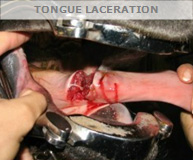
DIAGRAM - BOTTOM JAW OF A HORSE The effect of a bit on the bars, mouth, teeth, tongue and trigeminal nerve'Nutcracker' is the well used, but little understood action of a loose ring snaffle - a commonly used bit which is termed the most gentle. This type of bit is familiar to many people, however when one observes the action of it, there is nothing gentle about it. Pressure from the reins pulls the ends of the bit downward onto the bars of the mouth, whilst driving the centre jointed section directly up into the soft, sensitive, nerve rich roof of the mouth. A restricting flash is often used to hold the mouth of the horse closed as much as possible, which ensures the action of the bit is even more painful, and also unavoidable. Often a quick hard yank of the reins, either on the ground or when mounted, is used as a discipline which not only takes the horse by surprise, and which causes an extreme amount of pain, but also destroys any possibility of maintaining a trusting relationship. Whether very little rein pressure or extreme force is applied to the bit, the mere fact that it is placed in the mouth causes widespread dysfunction in body processes, and creates discomfort, pain, short and long term diseases and injuries along with extreme psychological stress. Examples :
Simulated bit pain exerciseAs an example of the pressure in a horse's mouth and how a bit must feel to a small extent - put the head piece of a bridle over your head. Now holding your arms stretched out in front of you and your palms facing each other with thumbs pointed upwards, place the bit on your hands. Ask someone to gather the reins in their hands and exert normal 'contact' pressure. Whilst holding this firm contact, ask them to exert additional single rein pressure to simulate a turn. Again, whilst holding this firm contact, ask them to exert more pressure with both reins to simulate a halt. Now ask the person to yank the reins, when impatient with the horse, enforcing a command or when trying to regain balance, or hold a horse back from bolting. It hurts a great deal! One can only imagine the physical pain suffered by a horse when a bit is placed in the mouth, which is far more sensitive than human hands. The emotional torment of not being able to avoid or run away from this pain - of being trapped - and having to suffer whatever the rider does must be unimaginable torture. |