|
THE TRUTH ABOUT BITS - PART 6 : THE EFFECTS OF POLL FLEXION + ROLKUR...
Flexion of the poll is not only desired and encouraged from the lowest level pony club ribbon days, to the highest of competitive events, but it is mandatory in many equestrian disciplines. To force a horse to flex it's neck and furthermore to make this cruel practice both mandatory and very much desired shows just how little understanding or regard the international equestrian federations have for the plight of the horse. With it's balance and vision so impaired by held poll flexion, or hyper flexion both horse and rider are placed in a position of extreme danger. Manual or false collection which is achieved by the rider holding the head and neck in a bent position through pressure on the reins - therefore holding the horse in position because of pain from the bit, produces not only physical suffering, but also profound psychological damage to the horse. Even if poll flexion is something a horse does naturally for more than a few seconds - which it does not, then flexion and collection should therefore be able to be achieved and maintained without the use of bit pain as the primary initiator. If poll flexion cannot be held by the horse naturally, without artificial aids, then it becomes a very questionable practice. Because of the unbearable and distressing pain suffered by the horse in held poll flexion, it will, depending on the personality of the horse, manifest it's suffering in various ways either at the time or on other occasions, but which unfortunately is usually not related by riders, to this most cruel and inhumane practice.
On the head, neck and vision
Horses have a highly developed sense of balance, due to their ability to feel the terrain underneath them at all times. This is attained from extremely refined proprioceptive responses - simply that the nerve impulses and messages which travel to the brain and back to the body function extremely quickly and efficiently. The horse is able to interpret these messages and make the necessary minute adjustments to retain balance over challenging surfaces in split seconds, and this is especially important when a horse is being exercised at maximum speed. For a horse to be able to receive these impulses, it is essential that it be allowed to move in a natural way - how the body was designed to move. Restriction of any kind of natural movement impairs this function with the resultant lack of co-ordination and injuries which follow. Flexion or hyper flexion also creates :
- Stress on the atlanto occipital joint : One of the joints which sustains balance and enables the horse to recover from over balance and falling is located at the top of the head. This joint - the atlanto occipital joint is where the skull and the first cervical vertebrae meet. When a horse begins to increase it's pace, or when particular tasks are required, the head and neck naturally extend in rhythm with it's striding and breathing. Occasionally and for extremely short periods of time - seconds in fact, when a horse is excited or showing dominance, the joint is flexed voluntarily, but it is never held for more than a few seconds at a time.
When a horse's neck is held in place by an artificial device such as a martingale, or through bit pressure and held reins, an extraordinary amount of stress is placed on the atlanto-occipital joint, and the associated ligaments, tendons, muscles and nerves of the head, neck and back. This joint is not designed to be bent so acutely, and if so bent, and especially for long periods, leads to excessive strain and in some cases, dislocation of the vertebrae. To avoid and escape the excruciating pain caused by manually held poll flexion, a horse will often either bend it's head at an even more acute angle, or hollow the neck and force their head to the sky, as well as exhibiting other manifestations of distress either at the time, or at other times, seemingly unrelated to this event
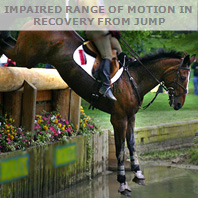
- Incorrect range of motion : In human terms, the use of our arms, torso, legs, etc are used to regain our balance or support us if we overbalance, or fall. Minute adjustments of our musculoskeletal system work in co-operation with each other to enable us to balance or regain our balance in situations which require it. A horse uses it's head and neck as a vital part of its balancing mechanism and without the freedom to move the head and neck naturally, especially at times of considerable and often unattainable demands, such as in competitive sprints, turns or jumping, the horse is restrained and restricted from moving in it's natural range of motion. Joints are designed to operate in a particular range, and repetitive restriction of this natural range creates not only dysfunctional wear on the joints and associated soft tissue, but also places unnatural strain on other body systems, which compensate for this impaired range of movement. Repetitive dysfunctional mechanical movement leads to acute and more long term disease as well as a great potential for injuries to both horse and rider
- Impaired vision : As well as excessive strain on the joints and soft tissue incurred from held poll flexion, the vision of the horse is greatly reduced because of the acute angle that the head and neck are manually held. A horse has an excellent field of vision, and uses it's head extensively to maintain the maximum field possible. When the head is held at an un natural angle, it is not only extremely dangerous in terms of a horse not being able to see the challenges which present themselves, but is extremely stressful for a prey animal to endure, who by nature must be on the lookout at all times for danger. Dire consequences result from many cross country competitive events, when riders insist on holding their horse's neck flexed not only between jumps when air flow should be maximised, but instead is decreased… but also when approaching excessively high or complex jumps that are incredibly challenging for a horse with a full field, let alone one who's vision is extremely restricted.
On the throat and airway
The walls of the windpipe which is around 80 cm in length, are supported by approximately 60 bands of roundish 'C' shaped cartilage. At exercise the head and neck of the horse naturally extends outward from extension of the atlanto-occipital joint, and breathing becomes more rapid and deep. The natural act of extension of the head and neck increases tension on the windpipe, which expands, stretches, straightens and strengthens it. Because of this process, the windpipe delivers the maximum amount of air possible to the lungs and becomes rigid enough to resist the suction force of increased inspiration.
- Flaccid airway : When the poll or neck is flexed, even for short periods of time at enforced exercise, the airway becomes over bent causing a restriction of airflow. The windpipe cannot naturally expand, stretch, straighten or become strong enough to maintain the increased forces of inspiration from increased demand at exercise. This increased suction pressure flattens the 'C' shaped cartilage, which become more elliptical in shape, thus restricting airflow even more. The over bent and flaccid airway, in combination with partial or full obstruction incurred from displacement of the soft palate and air entering into the normally sealed mouth, becomes vulnerable to collapse, and places both horse and rider in an extremely dangerous situation.
«Back to Articles
|
|
|