| MURPHY | 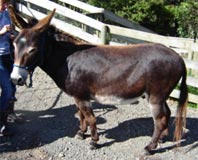 |
| BREED | : | Donkey |
| AGE | : | 5 years old |
| HEIGHT | : | 11 hh |
|
COMMENTS
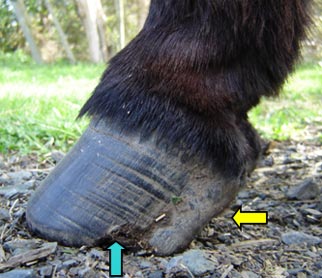
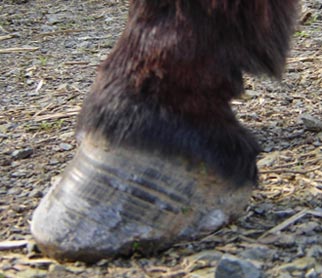
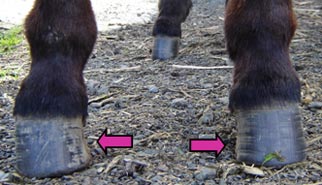
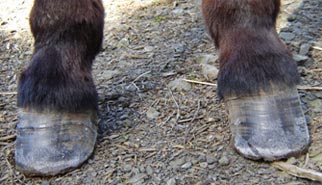
Murphy has been trimmed infrequently in the past by a master farrier. Although donkeys hooves are more narrow and upright, his hooves are far outside a functional shape. Because of poor trimming techniques, Murphy's front hooves have excessive weight distributed on the outside, which has caused a flare on the inside area. After one trim the improvement in weight distribution is obvious, however it will take a few trims for this to be corrected completely. The after photos do not show a perfect hoof, however the hooves are well on their way to becoming strong, healthy and well functioning. |
 |
|
 |
 |
Before 1st Corrective Trim
Left Front - Side View
15.09.08 |
|
After 1st Corrective Trim
Left Front - Side View
15.09.08 |
|
 |
|
 |
|
Before 1st Corrective Trim
Both Fronts - Front View
15.09.08 |
|
After 1st Corrective Trim
Both Fronts - Front View
15.09.08 |
|
High heels - observation
The heels are too high, which promotes a toe first landing. This inhibits extension of joints in the limb, places stress on the tendons and ligaments, and incorrectly distributes weight onto the front area of the hoof - an area not designed to incur such extreme force. (yellow arrow)
Action taken
By lowering the heel height as much as possible, the weight is more correctly distributed which promotes a heel strike. This results in the correct utilisation of shock absorption structures, expansion of the hoof and also extension of the limb.
|
Splits and chips - observation
The splits, chips, cracks and breakages have occurred due to a combination of factors - usually poor hoof horn along with either infrequent or incorrect trimming. (turquoise arrow)
Action taken
The splits, chips, cracks and breakages have been removed as much as possible. With consistent and correct trimming these will not reoccur.
|
Flares one side - observation
Misalignment of the skeletal structure or incorrect trimming has contributed to excessive strain on one side of the hoof. Because of this uneven weight distribution, one side has grown long and flared which indicates there is probable stretching of the laminar/wall connection. (pink arrows)
Action taken
The alignment is now corrected and supported as much as possible. With each consecutive and consistent trim the flaring will be resolved.
|
White line disease - observation
Opportunistic bacteria/fungi have multiplied in the stressed tissue space, resulting in white line disease.
Action taken
Non invasive removal of the dead and infected tissue, frequent trimming and most importantly removal of the cause ensures that it will not spread further. Over time diseased tissue will be replaced with healthy and functional regrowth.
|
Dead tissue on soles - observation
From lack of ground contact and/or movement, dead sole tissue has failed to exfoliate.
Action taken
After removal of built up dead tissue, the sole has transformed into a functional more concave structure.
|
| Back to Hoof Trimming Gallery |