| NIKKI | 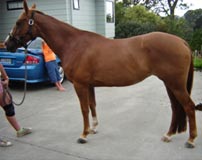 |
| BREED | : | Unknown |
| AGE | : | 11 years old |
| HEIGHT | : | 15 hh |
|
COMMENTS
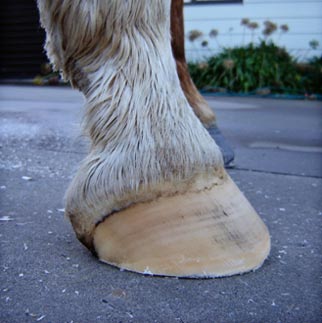
Nikki has had ongoing shoulder problems for many years, most noticeably after her shoes have been replaced. This was resolved after just one trim, and she is now sound and being brought back into work on various terrains. Her hooves had a large range of problems but have become healthy, strong and function perfectly after just three 4 weekly trims. |
 |
|
 |
 |
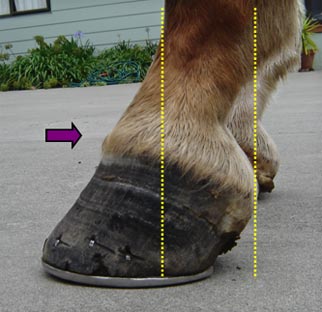
Before 1st Corrective Trim
Left Front - Side View
21.02.09 |
|
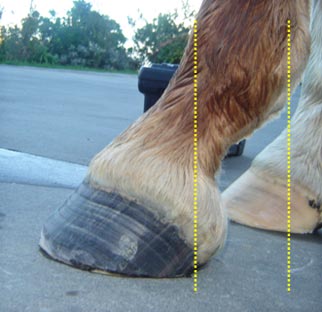
Transformed 3 Months Later
Left Front - Side View
15.05.09 |
|
 |
|
 |
|
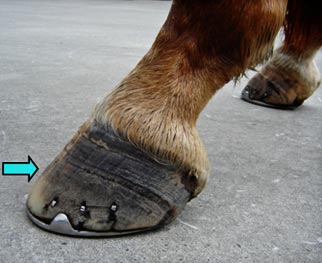
Before 1st Corrective Trim
Right Front - Side View
21.02.09 |
|
Transformed 3 Months Later
Right Front - Side View
15.02.09 |
|
 |
|
 |
|
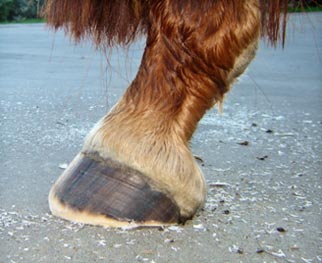
Before 1st Corrective Trim
Left Hind - Side View
21.02.09 |
|
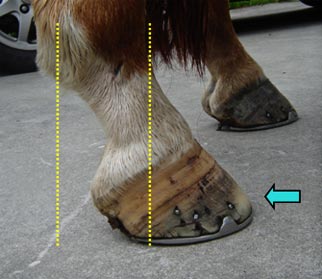
Transformed 3 Months Later
Left Hind - Side View
15.02.09 |
|
 |
|
 |
|
Before 1st Corrective Trim
Right Hind - Side View
21.02.09 |
|
Transformed 3 Months Later
Right Hind - Side View
15.02.09 |
|
 |
|
 |
|
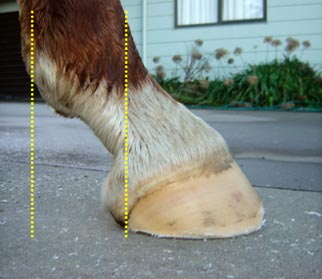
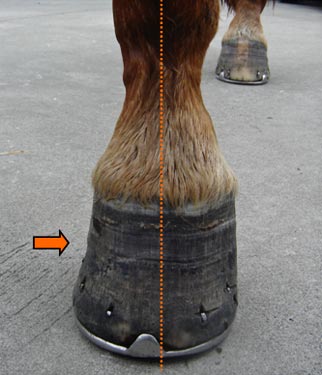
Before 1st Corrective Trim
Left Front - Front View
21.02.09 |
|
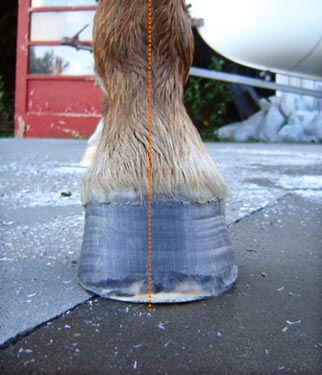
Transformed 3 Months Later
Left Front - Front View
15.02.09 |
|
High heels - observation
The heels are too high, which promotes a toe first landing. This inhibits extension of joints in the limb, places stress on the tendons and ligaments, and incorrectly distributes weight onto the front area of the hoof - an area not designed to incur such extreme force. (yellow dotted lines)
Action taken
By lowering the heel height as much as possible, the weight is more correctly distributed which promotes a heel strike. This results in the correct utilisation of shock absorption structures, expansion of the hoof and also extension of the limb.
|
Long toes - observation
The toes are too long from either incorrect or infrequent trimming. Break over becomes difficult and excess force is placed on the toe area of the hoof resulting in compromised wall/laminar connection. (turquoise arrows)
Action taken
The excess toe has been removed as much as possible and a mustang roll applied according to the thickness of hoof wall. Leverage forces are removed, thus facilitating a tight wall/laminar connection.
|
Splits and chips - observation
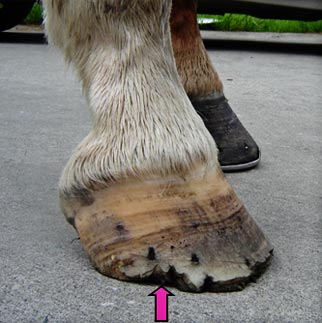
The splits, chips, cracks and breakages have occurred due to a combination of factors - usually poor hoof horn along with either infrequent or incorrect trimming. (pink arrow)
Action taken
The splits, chips, cracks and breakages have been removed as much as possible. With consistent and correct trimming these will not reoccur.
|
Flares one side - observation
Misalignment of the skeletal structure or incorrect trimming has contributed to excessive strain on one side of the hoof. Because of this uneven weight distribution, one side has grown long and flared which indicates there is probable stretching of the laminar/wall connection. (orange arrow & orange dotted lines)
Action taken
The alignment is now corrected and supported as much as possible. With each consecutive and consistent trim the flaring will be resolved.
|
Coronet band - observation
Note the angle of the coronet band - it is almost ground parallel which indicates excessive weight bearing force is centred on the toe area rather than the heel. (purple arrow)
Action taken
Immediately following this trim, the coronet angle is now improved.
|
Thin hoof walls - observation
Thin hoof walls can originate from a number of causes, and are often an indication that the hoof is not functioning as nature has designed. Often genetic tendencies are blamed for thin hoof walls, but it is more often the practice of shoeing, incorrect trimming or lack of exercise which has created hoof dysfunction, and therefore can be corrected very easily over time with owner commitment.
Action taken
With frequent correct barefoot trimming, along with plenty of exercise on hard, flat surfaces, hoof walls will become thick and healthy.
|
Dead tissue on soles - observation
From lack of ground contact and/or movement, dead sole tissue has failed to exfoliate.
Action taken
After removal of built up dead tissue, the sole has transformed into a functional more concave structure.
|
Black thrush - observation
Little or no contact of the sole with the ground has prevented it from exfoliating naturally. This has caused a build up of dead tissue which has been invaded by bacteria/fungi, giving the affected area a blackish appearance on the surface. When partially removed, a crumbly white interior is revealed.
Action taken
With the cause of the problem removed along with all dead tissue - stimulation by ground contact will prevent this from reoccurring.
|
| Back to Hoof Trimming Gallery |